New Funding Announcement
Latest Blog - Expertise still fundamental for under 11M schemes

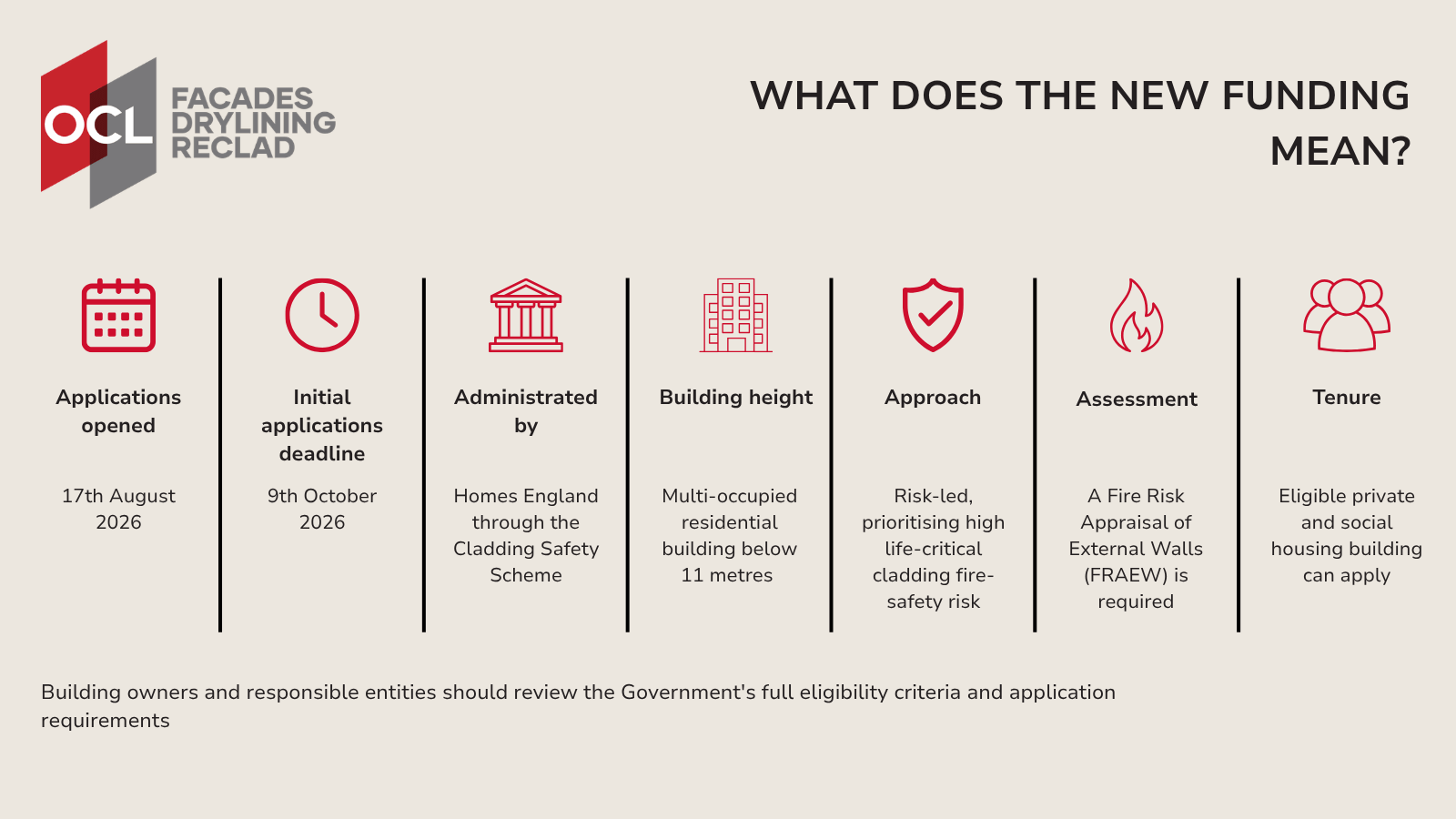
Under 11m New Funding
Tommy Occleshaw - Preconstruction Director
3-4 mins
1st September 2026
___________________________________________________________________________________________________________
The extension of cladding remediation funding to eligible residential buildings below 11 metres opens another route towards safer homes but building height does not reduce the technical complexities or human responsibilities involved.
___________________________________________________________________________________________________________
The Government’s announcement of remediation funding for residential buildings below 11 metres last month, marks another important step in the UK’s building-safety programme. It provides a route for eligible buildings where unsafe cladding presents a fire-safety risk.
For residents and building owners, the announcement offers hope and a new route towards addressing buildings that may have previously fallen outside of existing remediation programmes. For the construction industry, it brings greater focus to a part of the market where specialist remediation expertise will remain critical.
Tommy Occleshaw
Affected buildings still need to move from assessment, investigation through design compliance, procurement and then onto construction. However, being below 11 metres does not necessarily mean it’s straightforward.
Low rise buildings can contain many of the same facade and construction challenges you would find on taller buildings. For example, Original records being incomplete or differ from what was actually constructed, intrusive surveys uncovering unexpected wall build-ups, combustible materials, defective cavity barriers and serious defects.
Simply identifying the unsafe material and replacing it, is rarely the case.
We know that successful remediation requires an understanding of the complete external wall systems, the defects that need addressing and how the proposed solution interfaces with elements of the building that are being retained. This is where specialist facade and remediation experience become particularly valuable.
A FRAEW (Fire Risk Appraisal of External Walls) identifies and assesses wall fire risk. It does not, on its own, turn that assessment into a construction project. Further investigation is likely to be required, designs need to then be developed and coordinated, interfaces resolved, materials selected and then procured. Access and logistics need planning with costs and programmes reflecting what can realistically be delivered. We can support you from the get go.
At OCL Reclad Limited, our involvement does not need to begin when a completed remediation design arrives for tender. We are fully equipped to support clients and their teams through:
For clients with responsibility for multiple remediation building requirements, we understand the importance of early engagement to help a consistent approach to investigation, design, procurement and delivery across a wider portfolio whilst ensuring we value engineer where possible.
At OCL, these standards and processes have been developed through the delivery of larger and complex facade and remediation schemes of varying sizes. The extension of funding below 11 metres creates an opportunity to apply that same technical rigour and expertise to a wider range of residential buildings.
| What clients should look for in a remediation partner:
· Demonstrable facade and recladding experience · Strong design-management and compliance processes · Quality assurance that produces a clear audit trail · Experience of delivering within occupied buildings · A credible resident liaison strategy |
Speak to OCL about early design input, resident liaison and specialist facade delivery, or email estimating@ocl.london

Berkeley Homes
Berkeley Homes
£4.1m
60 weeks
 VIEW PROJECT

Berkeley Homes
Berkeley Homes
£19m
100 weeks
VIEW PROJECT

Berkeley Homes
Berkeley Homes
£10m
63 weeks
VIEW PROJECT